Dear culinary teacher,
Teachers work about 10 hours a week past their contract, according to RAND’s 2025 survey of US teachers.
In a foods room, lab day adds its own list on top of that: the grocery list times six kitchens, who does what, the allergy list, the demo, and how to fit cooking and cleanup into one period.
And when the plan has gaps, the period shows it. Fourth period, pancake day: Kitchen 2 is still measuring flour at minute 30, Kitchen 5 has one student doing all the work, and the sinks are full eight minutes before the bell.
This kit gives you those Sunday nights back. Every lab is already planned, so you open it, print it and teach it.
Why the usual lab plans fall short
Most recipes are written for one cook with an hour. Most culinary teaching material is written for a training kitchen, with commercial ranges and long blocks.
Your room has home-style ranges, one sink per kitchen, a bell every 50 minutes and four teenagers at every stove. The plan that works there has to say what happens at minute 11, who washes the bowl while the pancakes cook, and how much the eggs cost.
So we wrote that plan, 36 times.
The Culinary Lesson Vault: a ready lab for every week of the school year
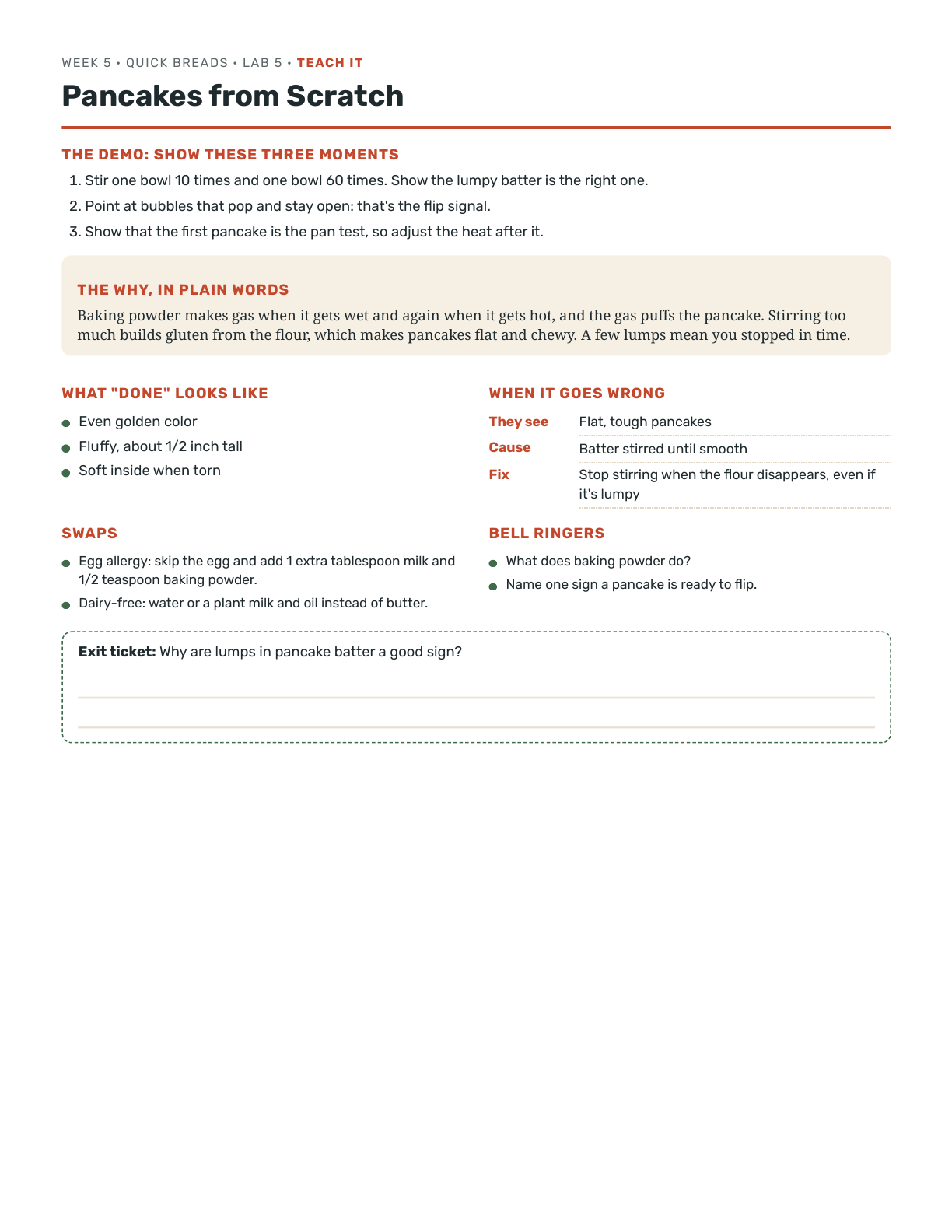
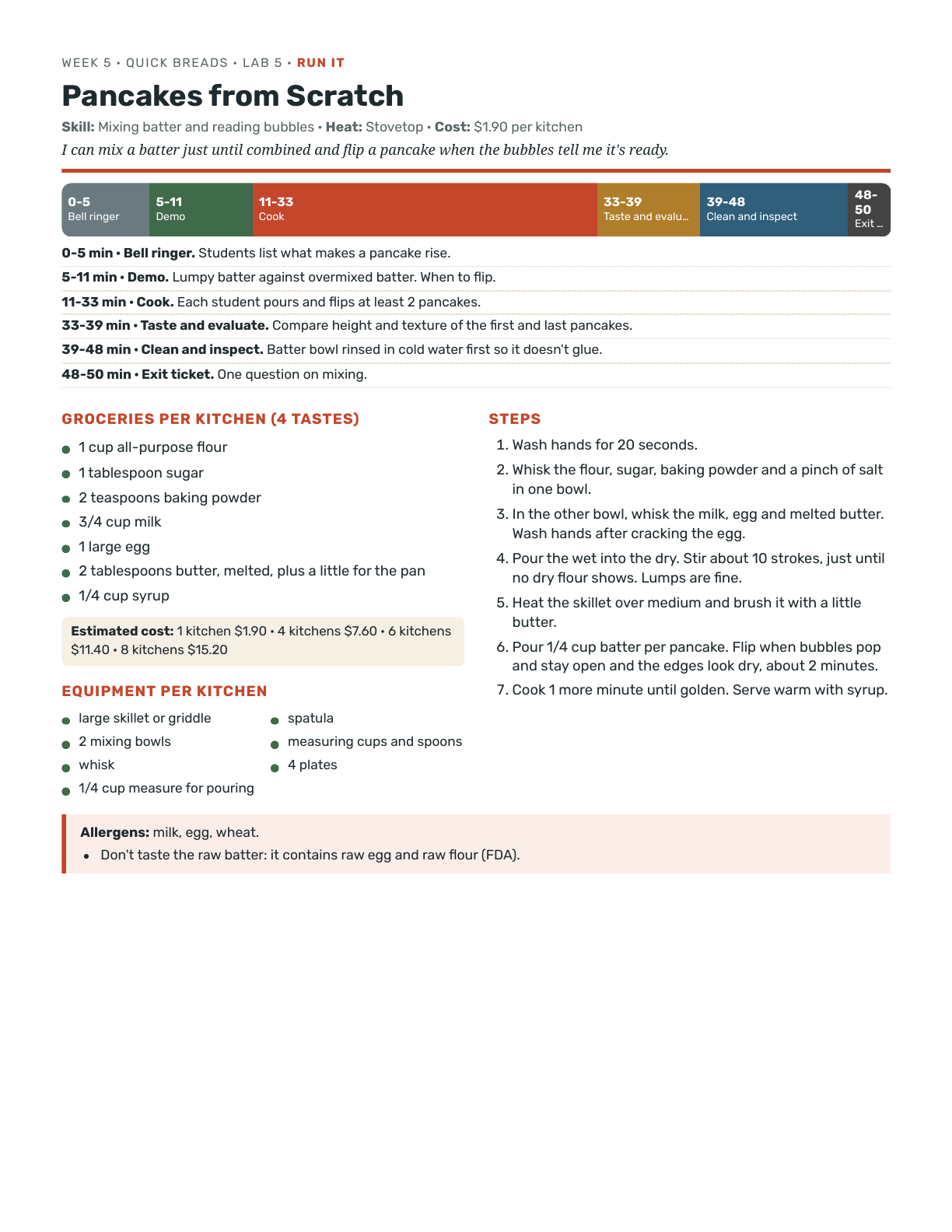
Each lab is two pages. Run it goes on your clipboard. Teach it is for the night before.
- A 50-minute timeline. Bell ringer, demo, cook, taste, clean, exit ticket, to the minute. Oven labs are timed so cleanup happens while things bake.
- Four roles that rotate. Head Cook, Prep Cook, Sanitation Lead and Materials Manager, with a 36-week rotation chart, so every student holds the knife and every student washes the bowl.
- Groceries and cost. The list for one kitchen, and the estimated cost for 1, 4, 6 or 8 kitchens. Pancakes run about $1.90 a kitchen. The typical lab is about $4.
- Allergens and safe temperatures. The nine major allergens marked on every lab, and the USDA temperature on every lab with chicken, ground beef or fish.
- The demo in three moments. What to show, what to point at and the food science in plain words, so the demo stays short.
- When it goes wrong. What students will see, what caused it and the fix, plus swaps for allergies and a tight budget.
The year runs from knife safety and measuring in week 1 through eggs, quick breads, pasta, sauces, soups, poultry, cookies, yeast dough, fish, rice, global dishes and a mystery basket, to a team practical in week 36.
See a real lab
These are the two pages for Week 5, Pancakes from Scratch, straight from the kit. Tap one to open it full size.
$27 once · Instant download · Use it this week
Here’s everything you get
The labs come with the books that make them run: the first two weeks of safety lessons, roles, budget, rubrics, the allergy and safety playbook, and what to do when the lab changes. Each bonus fixes one more thing that gets in the way.
The core
36 lab cards and 8 teaching books
Every lab on two pages, plus Start Here and the year map, the first two weeks, kitchen roles and rotation, the grocery and budget planner, rubrics and grading, the allergy and safety playbook, when the lab changes, and capstones and practicals.
Value $39
Bonus 1 · for “they don’t read the handout”
Student Recipe Cards
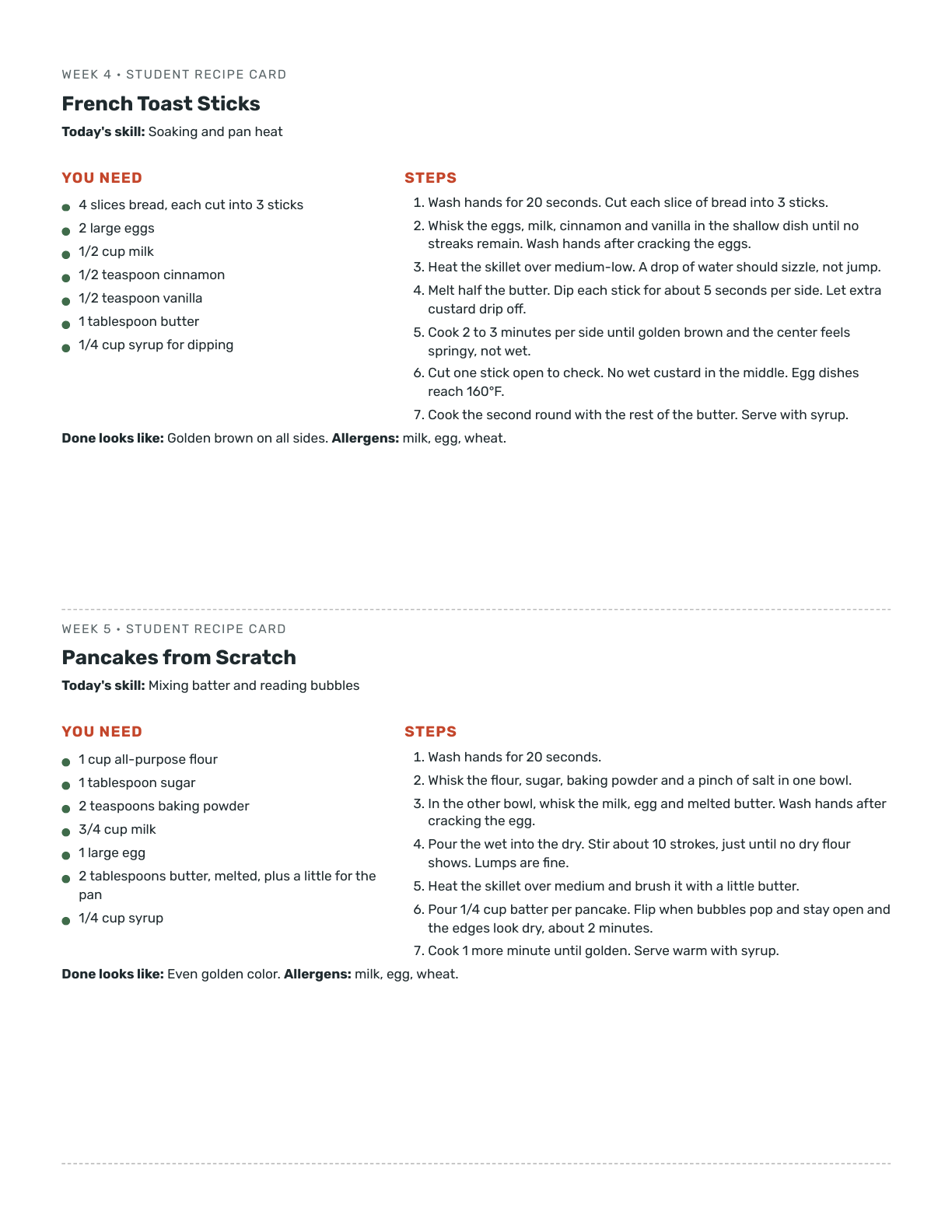
One card per lab in student words: what you need, the steps, what done looks like. Two to a page, one per kitchen.
Value $9
Bonus 2 · for “what do they do while I take roll?”
Bell-Ringer and Exit-Ticket Bank
72 bell ringers and 36 exit tickets, two and one for every week, tied to that week’s lab.
Value $7
Bonus 3 · for “they forget the rules by October”
Kitchen Wall Posters
Six posters: handwashing, safe temperatures, knife rules, cleanup order, the nine allergens and what to do in a grease fire.
Value $5
Bonus 4 · for “I need the forms back before lab 1”
Parent Letters and Forms
A welcome letter, an allergy and dietary form, a lab contract, a lab fee letter and a donation request, ready to print.
Value $7
Bonus 5 · for “I know food, not 28 teenagers”
The Chef-to-Teacher First-Year Guide
Running the room, calling the clock, grading the role instead of the plate, and the five things that go wrong in a first year.
Value $9
So what does it cost?
Add up what’s in the kit:
| 36 lab cards and 8 teaching books | $39 |
|---|---|
| Bonus 1: Student Recipe Cards | $9 |
| Bonus 2: Bell-Ringer and Exit-Ticket Bank | $7 |
| Bonus 3: Kitchen Wall Posters | $5 |
| Bonus 4: Parent Letters and Forms | $7 |
| Bonus 5: The Chef-to-Teacher First-Year Guide | $9 |
| Total value |
For comparison, a single two-week culinary unit sells for $21 to $26 on teacher marketplaces, and full-year bundles start around $99.
You won’t pay $76. You won’t even pay the $39 the labs are worth alone.
Today, the whole year is $27, one time.
That’s 75¢ a lab. No subscription, ever.
- 7-day money-back guarantee. Run one lab from it. If it didn't make lab day easier, one email gets every cent back.
- Instant PDF download. On your phone in a minute.
- Secure checkout by Stripe.

Now picture next week
Monday night you open next week’s lab, print the Run it page and send the grocery list. Tuesday the bell ringer is on the board, the demo takes six minutes, and every kitchen knows who is cooking and who is on dishes.
At minute 48 the Materials Managers are walking the inspection checklist and you’re reading exit tickets. Sunday night stays yours.
Run one lab. Then decide.
Run one lab from the kit. If it didn’t make lab day easier, send one email within 7 days of purchase and we refund every cent. No forms. No hoops.
So the risk is all ours.
The Culinary Lesson Vault is a teaching resource. Your school’s safety, food-handling, allergy and grading procedures always come first. Grocery costs are estimates from typical 2026 US prices; check your store. Safe temperatures follow the USDA FSIS chart.